
The Art of Old Dough Fermentation: Why Can't the Taste of 40 Years Ago Be Replaced Today?
- shu chan tang
- Feb 8
- 3 min read
Introduction | Time is part of flavor
In an era where efficiency reigns supreme, industrial yeast can rapidly expand dough and produce stable results in a short time ; however, some flavors and textures simply cannot be replicated in a rush. Foo Chow Food has taken a "slow and steady" approach, persisting for 40 years: sourdough fermentation. This is not an obstinacy with tradition, but a long-term collaboration involving time, microbial flora, and temperature—to create a deeper aroma and lingering sweetness in every bite of soft and fluffy bread .

The Origin of Sourdough Fermentation: Wisdom from Traditional Pastry Making
The practice of using sourdough originated in ancient China and is a fermentation technique based on the symbiotic relationship between natural yeast and lactic acid bacteria . In the days before industrial yeast, masters would reserve a portion of the fermented dough as a starter for the next batch, continuing this process day after day.
Over time, these old doughs have developed a stable and diverse microbial community, which has become the source of the unique flavor of each old shop.
Characteristics of the Old Dough Fermentation Process
The fermentation process is relatively slow, but requires more precise judgment.
Compared to modern instant leavening agents, sourdough fermentation does not aim for rapid expansion. The fermentation process relies more on the master baker's judgment of the following conditions:
Temperature change
Humidity control
dough state
Fermentation odor
These cannot all be accomplished entirely by machine settings.

A richer natural flora
Sourdough typically contains a variety of natural yeasts and lactic acid bacteria, rather than a single species. During fermentation, these microorganisms work together to produce more layers of aroma and flavor compounds.
More complex flavor structure
As fermentation continues, various organic acids and aromatic substances gradually form in the dough, giving the finished product its characteristic appearance:
The aroma is richer
The flavor is not bland
A longer-lasting aftertaste
This is precisely the difference that many long-time customers can tell as soon as they taste it.
The effect of sourdough fermentation on steamed buns
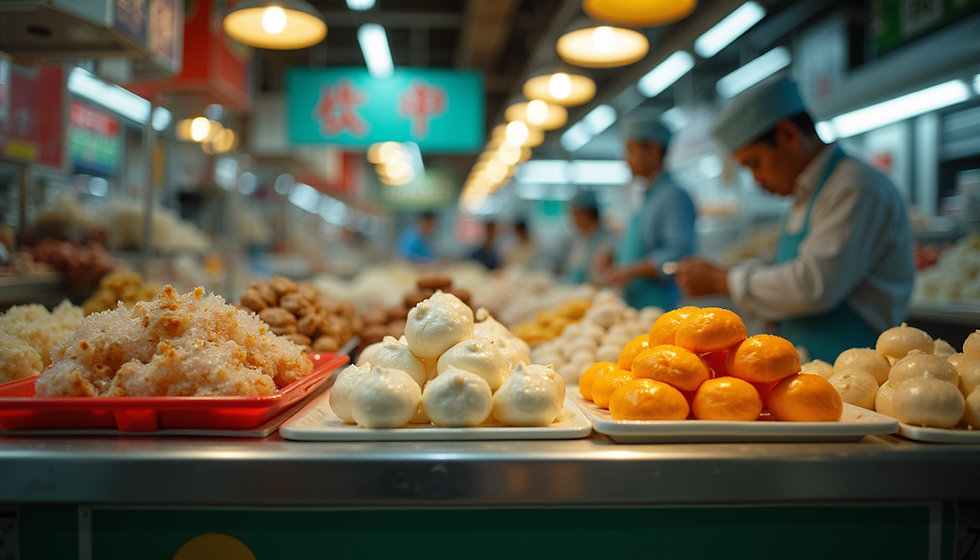
The advantages of using sourdough for fermentation are particularly evident when making Chinese-style steamed buns.
Compared to steamed buns made using only industrial yeast, sourdough fermentation often results in the following characteristics:
The texture is softer but elastic , not airy.
The aroma is more natural , not pungent or monotonous.
Steaming stabilizes the texture and prevents it from collapsing quickly.
The texture changes less after reheating , which is more conducive to food production.
These characteristics are often more important than "getting up quickly" for restaurants, stalls, and wholesale customers.

Why is it still difficult for modern production to completely replace sourdough fermentation?
In industrial production, quick-fermenting agents do indeed offer advantages in efficiency and cost. However, they still struggle to completely replicate the results of sourdough fermentation for several reasons:
Using a single strain limits flavor development.
The fermentation time was too short, resulting in insufficient aroma layers.
The finished products tend to have a consistent taste and lack variety.
More importantly, the fermentation of old dough relies heavily on experience and judgment. Fine adjustments to temperature, humidity, and time often come from years of accumulated feel and observation, rather than from a single parameter.
This is why, even in modern production environments, factories and shops that truly insist on using old dough fermentation are still very few and far between.
Conclusion | Slowing down is not falling behind, but a choice.
Sourdough fermentation isn't about nostalgia, nor is it about rejecting modern technology. It's about choosing a method that respects time and the evolution of flavor. In Fuzhou steamed buns, the insistence on sourdough fermentation isn't because it's "most convenient," but because it allows each bun to leave behind something more memorable beyond its softness.
If you're looking for consistently delicious and suitable Chinese steamed buns for the food service industry , feel free to learn about our series of buns made using the traditional sourdough fermentation process. 👉Contact us via WhatsApp at 011-5662 7234 to discuss wholesale and partnership opportunities.
Comments